Skip to content

Hybrid Cloud

Run Every Workload Where It Works Best

Masthead 4-May-01-2026-04-28-24-6337-PM

The Right Workload. The Right Platform.

Hybrid Cloud from Node4 mixes the best infrastructure across Colocation, Private Cloud, Microsoft Azure and our Virtual Data Centre, giving you a flexible way to run workloads where they work best. 

Our Hybrid Cloud solution gives you the flexibility to run workloads where they deliver the most value, moving seamlessly between platforms as business needs evolve. Keep sensitive data secure within sovereign UK infrastructure while leveraging the scale and innovation of public cloud services, all with the agility to increase resources on demand without investing in costly new hardware.


Ryan

Build Your Hybrid Cloud in Seconds

Cost & Commercial Step 1 of 8 · 0%

Question

Your Hybrid Cloud Blueprint

Based on your answers, here's how we'd distribute your estate.

Platform Mix

Recommended distribution across platforms.

Visual Breakdown

Same data, different view.

What each platform delivers

Why we placed workloads where we did.

Key Insights

Signals we picked up from your answers.

How Node4 joins it all together

A hybrid mix only works when the platforms behave like one estate. This is the glue we bring.

Recommended Next Step

Hybrid Blueprint Review

YOUR REPORT IS READY

Download Your Hybrid Cloud Blueprint

Speak to a Node4 Cloud Architect

We'll walk through this recommendation with you.

Done

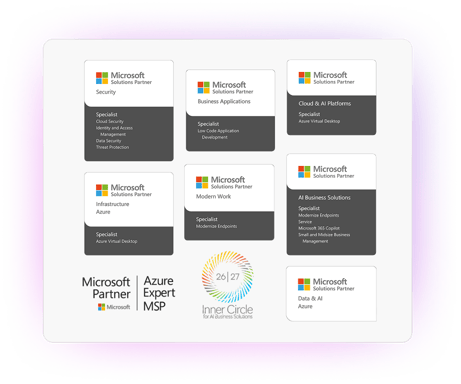
Top 1% of Microsoft Partners, Globally

We’re an end‑to‑end Microsoft partner with all six Solutions Partner designations, five consecutive Inner Circle years, 3,000 certifications, and Direct CSP status – delivering priority access, funding, and expert support.
MS Badges

The Outcomes You Can Expect From Hybrid Cloud

Why Node4 for Hybrid Cloud?

Hybrid Cloud = Public Cloud Modernisation + Sovereign Control + FinOps, under one operating model.

Node4 delivers secure, scalable and cost-effective hybrid cloud solutions that help businesses innovate without compromise.

  • check_circle
    check_circle

    Sovereign solutions in times of strict compliance

    Our UK sovereign colocation data centres give businesses the secure, resilient infrastructure they need to modernise while maintaining complete control over their critical workloads.

    For businesses operating in highly regulated sectors such as finance, healthcare and the public sector, keeping sensitive data within ISO-certified UK environments becomes simpler, helping you meet compliance requirements without compromising on performance or flexibility.

  • check_circle
    check_circle

    The power of public under a single management system

    Node4 utilises tools like Microsoft Azure Arc and Azure Stack HCI to bridge your environments. With unified tooling, you can use the exact same APIs, skills, and security monitoring for your on-premises hardware as you do in the public cloud.

  • check_circle
    check_circle

    Legacy protection and cost control

    Moving older apps to the cloud is often expensive or impossible without a complete rebuild. With Node4, you can keep predictable, legacy workloads on cost-stable colocation or private servers, whilst having dynamic apps (like AI or analytics) in public Azure

  • check_circle
    check_circle

    No ‘bill shock’ and true self-service control

    With consumption-based pricing means you only pay for resources used without unpredictable public cloud fees.

Hybrid Cloud, The Node4 Way

By bringing together Azure, Private Cloud, Virtual Data Centre and Colocation under a single operating model, we help businesses balance innovation, compliance and cost while maintaining complete visibility and control across their infrastructure estate.

hybrid vs trad

Frequently Asked Questions

How does hybrid cloud management differ from traditional cloud management?

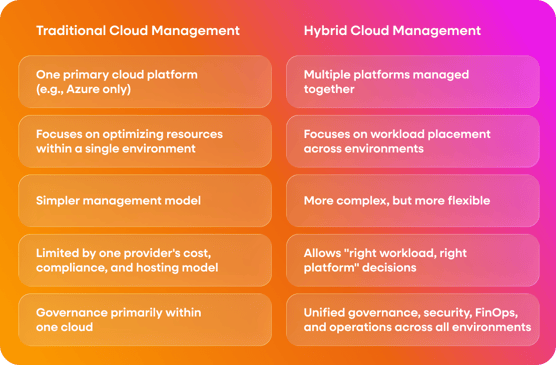
The key difference between hybrid and traditional cloud management is that the latter focuses on managing resources within a single cloud environment. Hybrid cloud management governs and operates workloads across multiple environments, including public, private, and sovereign clouds, colocation, and on-premises infrastructure, through a unified operating model.

Can you explain the different types of hybrid cloud architectures?

The main types of cloud architecture are public cloud, private cloud, hybrid cloud and multi-cloud. Public cloud focuses on scalability, and private cloud provides greater control. Hybrid cloud combines multiple environments to deliver the right balance of performance, security, compliance and cost. The best architecture depends on your business requirements, workloads and long-term IT strategy.

What are some real-world examples of companies benefiting from hybrid cloud?

Businesses benefit from hybrid cloud by placing workloads where they perform best. For example, Brintons Carpets adopted a hybrid cloud approach to modernise its IT infrastructure, improve performance and flexibility, and support business growth. Similarly, Benenden Health relies on hybrid cloud to support critical healthcare services for more than 800,000 members around the clock.

Hybrid cloud helps organisations balance performance, security, scalability and cost across their IT estate.

Can hybrid cloud solutions help reduce IT costs and complexity?

Yes. Hybrid cloud can help reduce both IT costs and operational complexity by allowing your business to run each workload in the most appropriate environment that is required. This helps avoid unnecessary public cloud spend, allowing you to maximise existing infrastructure investments, improve resource utilisation and deliver consistent governance, security and management across cloud and on-premises/colocation environments.

What tools are most popular for managing cloud operations today?

Popular cloud operations tools include monitoring platforms, security solutions, automation tools and cost management services. Common examples include Azure Monitor for performance monitoring, Microsoft Sentinel and Defender for security, Terraform for infrastructure automation, Azure DevOps for deployment and collaboration, and FinOps tools for cloud cost optimisation. Combined, these tools help organisations maintain visibility, security, governance and control across cloud and hybrid environments.

How do I choose the right managed cloud service provider?

When choosing the right managed cloud service provider, you should look for proven cloud expertise across public and private, strong security and compliance credentials, 24/7 operational support, and a clear approach to governance, monitoring and cost optimisation. The right provider should not only manage your cloud environment but also help improve performance, security, resilience and long-term business outcomes through a partnership approach.

Secure, scalable, AI-enabled operations starts here

Speak to our Cloud and AI specialists